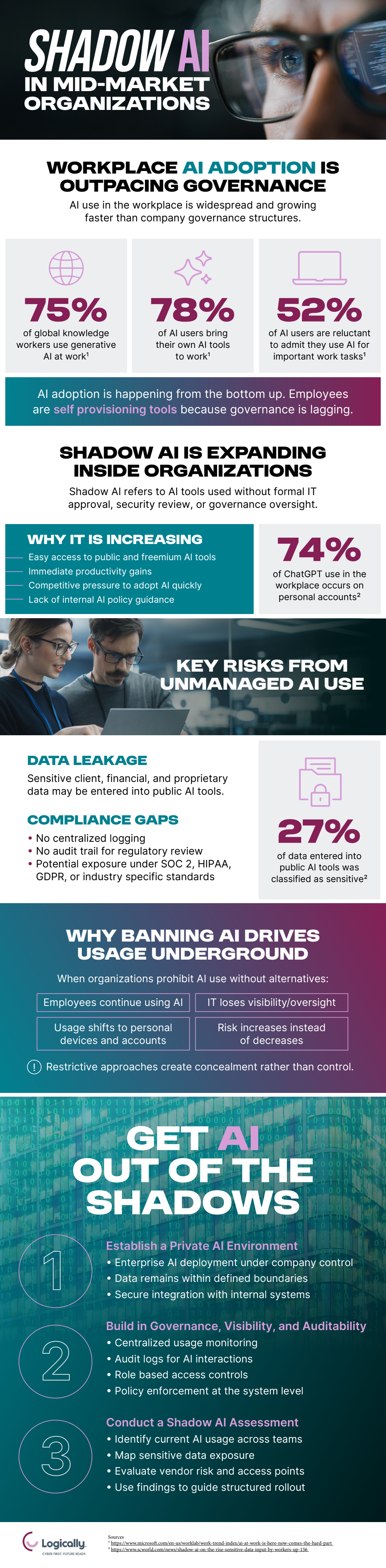
Shadow AI is becoming common in mid-market organizations. Employees often use AI tools without formal approval to speed up tasks or solve problems. While this can improve productivity, it also creates risk. Data exposure, inconsistent outputs, and a lack of oversight can affect business operations.
What Drives Shadow AI
Employees turn to AI tools when they need faster results. Many of these tools are easy to access and require little setup. Teams may use them for writing, data analysis, or customer communication.
In mid-market firms, formal systems may not keep pace with daily needs. This gap encourages employees to find their own solutions. Without guidance, these tools operate outside company controls. Understanding why employees adopt these tools is the first step in addressing the issue.
Identifying Where It Exists
Shadow AI often goes unnoticed. It may appear in personal devices, browser extensions, or external platforms. This makes it harder to track and manage.
Organizations should start by reviewing workflows and common tools used by teams. Surveys and internal discussions can reveal where AI tools are already in use. IT teams can also monitor network activity to identify patterns.
Setting Clear Usage Policies
Once shadow AI is identified, companies need clear policies. These should define what tools are allowed and how they can be used. Guidelines should also explain what data can and cannot be shared with external systems.
Policies should be simple and easy to follow. Overly complex rules can lead to low adoption. Employees are more likely to follow guidance that fits their daily work.
Providing Approved Alternatives
Blocking tools without offering alternatives often leads to more shadow use. Employees still need ways to complete their tasks efficiently. Approved AI tools should meet these needs while aligning with company standards.
These tools should be easy to access and supported by the organization. Training helps employees understand how to use them correctly. This creates a safer and more controlled environment.
Building Oversight and Accountability
Ongoing oversight helps maintain control as AI use grows. This includes tracking how tools are used and reviewing outputs when needed. Regular audits can help identify new risks.
Assigning responsibility is also important. Teams should know who manages AI use within the organization. This may include IT, compliance, or leadership roles. AI governance should be treated as an ongoing process. It requires updates as tools and needs change.
Encouraging Responsible Use
Employees play a key role in managing shadow AI. Training and communication help build awareness of risks and expectations. When employees understand the impact of their actions, they are more likely to follow guidelines.
Encouraging open discussion also helps. Employees should feel comfortable asking questions or raising concerns about AI tools. This creates a more transparent environment.
Shadow AI is not likely to disappear, but it can be managed with the right approach. Clear policies, approved tools, and ongoing oversight help reduce risk while supporting productivity. With a structured plan, mid-market organizations can move forward with greater confidence and control. Check out the infographic below to learn more.